


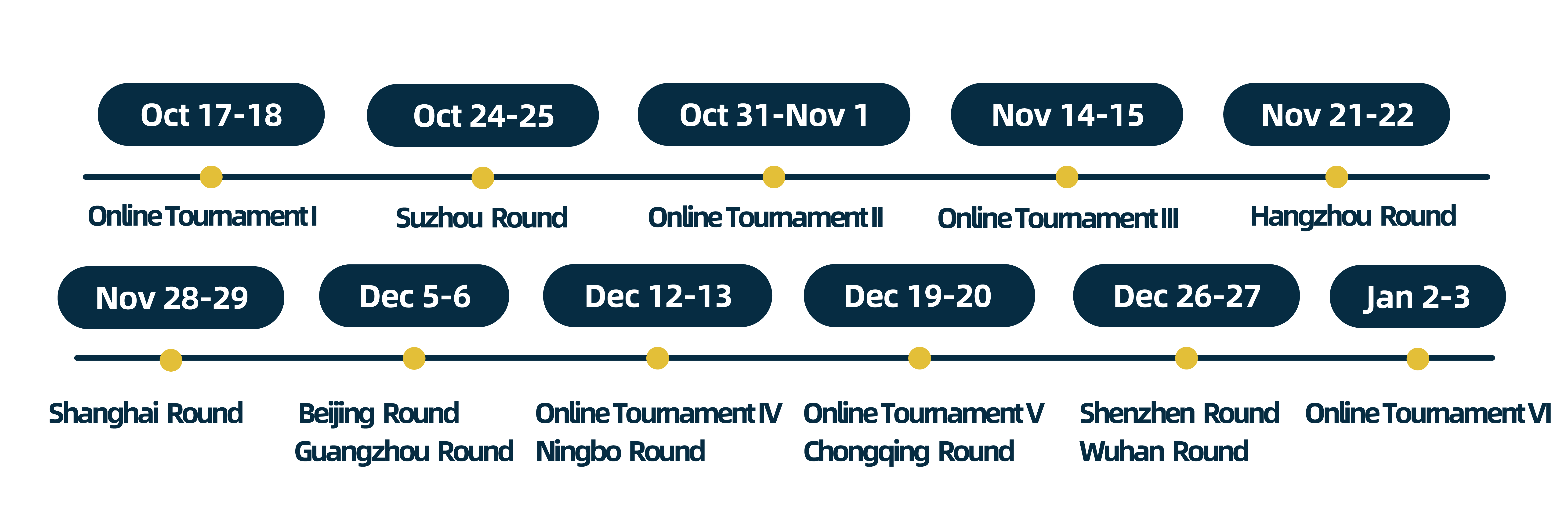

2026 Fall Regional Tournament Timeline

NHSDLC 2026 Fall Regional Tournament will be held simultaneously online and offline. Participants are requested to complete registration independently according to the schedule and division requirements.

NHSDLC Challenge Types

PF | Public Forum Debate

Suitable for: Primary, middle, and high school students

2v2 Team Debate

Current Issues

Research and Evidence

Argument and Rebuttal

Overview

Public Forum Debate, commonly known as PF Debate, is one of the most widely used American-style debate formats in China. The resolution is usually released by the Organising Committee before the competition. Each debate is conducted in a 2v2 format, with sides and speaking order determined randomly before the round begins. A full round lasts approximately 60 minutes, with the core debate sequence taking around 43 minutes. Teams debate current and public issues, using logical reasoning, research, and evidence to build their cases and persuade the judge.

Divisions

Middle School Novice Division
Open to students in Grade 9 or below who are participating in an NHSDLC regular competition season for the first time.
(eligible for Novice status throughout the current competition season)*

Middle School Division
Open to students in Grade 9 or below.

Open Division
Open to all students in Grade 12 or below.

* Students entering an NHSDLC regular competition for the first time during the Fall season remain eligible for the Novice Division throughout that entire Fall competition season. After the Fall season ends, they will no longer be eligible to enter the Novice Division.
【Division Selection Guidelines】Students in Grade 9 or below who are new to debate may choose the Middle School Novice Division. Students in Grade 9 or below with prior debate experience are encouraged to enter the Middle School Division. Students in Grades 10–12 may enter the Open Division.

【Important Note】
Division Merging Policy: In line with common practice in American-style debate competitions in China and internationally, if fewer than 10 teams participate in a division, the Organising Committee may merge divisions to ensure the competition runs smoothly.
Division merging will generally follow the priorities below:

  1. Debate experience takes priority. The Middle School Division and Open Division may be merged, with participants competing in either the Middle School Novice Division or the Open Division.
  2. Age is considered next. The Middle School Novice Division and Middle School Division may be merged, with participants competing in either the Middle School Division or the Open Division.

* The NHSDLC Organising Committee reserves the right to make the final determination on all competition rules.

Debate Order

Constructive

 

4 mins
Each Speaker 1
01

Crossfire 1


3 mins
Each Speaker 1
02

Rebuttal


4 mins
Each Speaker 2
03

Crossfire 2


3 mins
Each Speaker 2
04

Summary


3 mins
Each Speaker 1
05

Grand Crossfire


3 mins
All Speakers
06

Final Focus


2 mins
Each Speaker 2
07
The core debate sequence lasts approximately 43 minutes, including prep time.

Speaker 1
Constructive + Summary

Presents the team’s main arguments and reasoning, establishes the overall framework, and, in the Summary, highlights the key issues and compares the strengths of both sides.

Prep Time
4 minutes per team

Speaker 2
Rebuttal + Final Focus

In Rebuttal, responds directly to the opposing team’s arguments and defends the team’s case. In the Final Focus, distils the debate into its key issues and explains why the judge should vote for their team.

* Please refer to the latest official NHSDLC competition rules for specific rules and division requirements.

JWSD | Junior World Schools Debate

Suitable for: Students who are under 14 years old

3v3 Team Debate
Prepared and Impromptu Motions
Points of Information (POIs)
Comparative Argumentation and Teamwork

Overview

Junior World Schools Debate (Junior WSD) is an adapted version of the World Schools Debate format designed for younger students aged 7–13 who are under 14 years old. Each debate features two teams. A team may consist of 3–5 members, with three speakers from each team competing in each round. The teams represent the Proposition and the Opposition, delivering a total of eight speeches. JWSD combines prepared motions with impromptu motions. Prepared motions are released approximately one month before the competition. For each prepared motion, teams are given 10 minutes of on-site preparation time. Impromptu motions are announced at the competition, after which each team has 20 minutes to prepare. During each team’s first three substantive speeches, opposing speakers may offer Points of Information (POIs) between 00:30 and 03:30. Each POI may last no longer than 15 seconds.

Debate Order

Proposition Constructive
Speech Speaker 1
+
Opposition Constructive
Speech Speaker 1
4 mins each
01
→

Proposition Constructive
Speech Speaker 2
+
Opposition Constructive
Speech Speaker 2
4 mins each
02
→

Proposition Constructive
Speech Speaker 3
+
Opposition Constructive
Speech Speaker 3
4 mins each
03
→

Opposition
Reply
+
Proposition
Reply
2 mins each
04
The core debate lasts approximately 28 minutes, excluding pre‑debate preparation time.

Speaker 1
Establishing the Framework and Team Position
Defines and interprets the motion, establishes the team’s overall case, and presents the opening core arguments.

Speaker 2
Developing the Case and Responding
Responds to the opposing team’s arguments, defends the team’s existing case, and further develops its arguments.

Speaker 3
Rebuttal, Comparison, and Summar
Delivers deeper rebuttal, compares the arguments and impacts presented by both sides, and identifies the key areas of clash.
Reply Speaker:The Reply Speaker must be Speaker 1 or Speaker 2. The speaker summarises two or three key areas of clash and explains why their team should win the debate.
POI
During each team’s first three substantive speeches, opposing speakers may offer POIs between 30 seconds and 3 minutes 30 seconds into the speech. Each POI may last no longer than 15 seconds.
Schedule
The competition typically runs over two days, consisting of four preliminary rounds followed by elimination rounds.。
* Competition rules and division requirements are subject to the latest official NHSDLC competition rules.
Motions
During the preliminary stage, JWSD features two prepared motions and two impromptu motions. All motions used in the elimination rounds are impromptu.
*The first two preliminary rounds use prepared motions.
*Impromptu motions are announced on site for the final two preliminary rounds and all elimination rounds. After the motion is released, each team has 20 minutes to prepare and may consult only materials expressly permitted under the competition rules.

BP | British Parliamentary

Suitable for: Middle school, high school, and university students

Four Teams

Impromptu Debate

Points of Information (POIs)

Multiple Perspectives

Overview

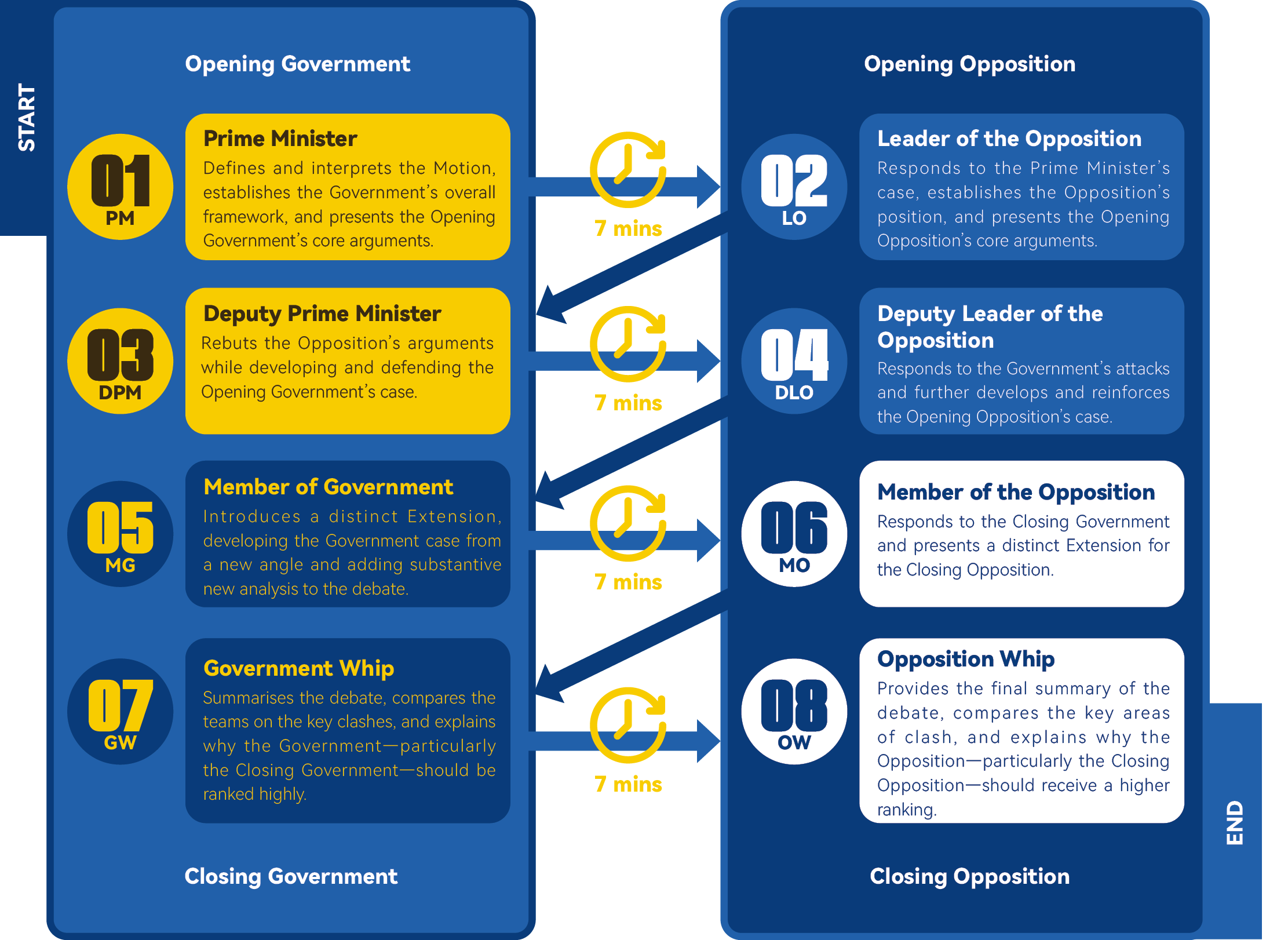
British Parliamentary Debate, commonly known as BP Debate, is one of the most widely used English-language debate formats at universities around the world. In BP Debate, the debate topic is called a Motion, a term derived from parliamentary procedure referring to a formal proposal put forward for consideration or action. BP is typically conducted as an impromptu debate. The Motion is usually released approximately 15 minutes before the competition begins. Each debate features four teams and eight debaters, divided into the Opening Government, Opening Opposition, Closing Government, and Closing Opposition. The core debate lasts approximately 56 minutes, with each debater delivering a 7-minute speech. Teams demonstrate their contribution through argumentation, rebuttal, Points of Information (POIs), and comparative analysis. At the end of the debate, the adjudicators rank all four teams based on their overall performance. Preparation time, POI rules, speech duration, and other procedural requirements are subject to the latest official NHSDLC competition rules.

Teams, Speaker Roles, and Debate Order
Key Feature: Points of Information (POIs)

When POIs May Be Offered
POIs may be offered at any time during a speech except during the first and sixth minutes, which are protected time.

POI Guidelines
A POI should be brief, direct, and relevant—for example: “How do you account for this inconsistency in the data?”

Responding to POIs
The speaker may choose to accept or decline a POI. However, speakers are generally encouraged to accept one or two POIs during a speech to demonstrate responsiveness and the ability to engage under pressure.

The core debate lasts approximately 56 minutes, excluding preparation and adjudication time.
* Preparation time, POI rules, and speech duration are subject to the latest official NHSDLC competition rules.

LD | Lincoln‑Douglas

Suitable for: Middle and high school students

Value‑Based Topics

One‑on‑One Debate

Logical Reasoning

Argument and Rebuttal

Overview

Lincoln-Douglas Debate (LD Debate) is a one-on-one debate format in which students compete individually rather than as part of a team. Unlike Public Forum (PF) Debate, which tends to focus more on current public issues and the impact of public policy, LD Debate places greater emphasis on value judgments and ethical principles. Debaters are expected to develop a clear position on the resolution and engage with competing values, such as individual liberty versus the collective good, economic development versus environmental protection, and rights versus fairness. They then defend their position through logical analysis, cross-examination, and rebuttal. LD topics generally draw from the same broad topic area as the PF topic for the corresponding competition season. The exact resolution is released in advance, allowing participants to prepare beforehand. Internet access is not permitted during the debate itself. A full LD debate lasts approximately 40 minutes and includes constructive speeches, cross-examinations, and rebuttals. LD Debate is particularly well suited to students who already have some debate experience, demonstrate strong analytical reasoning, and enjoy exploring philosophical questions and broader social values.

Debate Order

01
Affirmative Constructive
6 mins
The Affirmative presents its case, establishes its position, and introduces its key arguments.

02
Negative Cross‑Examination
3 mins
The Negative questions the Affirmative on the arguments and reasoning presented in the constructive speech.

03
Negative Constructive
7 mins
The Negative presents its case and responds to the Affirmative’s arguments.

04
Affirmative Cross-Examination
3 mins
The Affirmative questions the Negative on the arguments and reasoning presented in the constructive speech.

05
First Affirmative Rebuttal
4 mins
The Affirmative responds to the Negative’s case and rebuilds its own arguments.

06
Negative Rebuttal
6 mins
The Negative responds to the Affirmative’s case, rebuilds its own arguments, and explains why the judge should vote Negative.

07
Second Affirmative Rebuttal
3 mins
The Affirmative addresses the key voting issues raised by the Negative and explains why the judge should vote Affirmative.

Roles and Responsibilities

RoleAffirmativeNegative
ConstructivePresents the Affirmative position, establishes the value framework, and develops the key arguments.Presents the Negative position, establishes the value framework and key arguments, and responds to the Affirmative case.
Cross-ExaminationQuestions the Negative to test the logic, reasoning, and support behind its case.Questions the Affirmative to test the logic, reasoning, and support behind its case.
RebuttalResponds to the Negative’s arguments, rebuilds the Affirmative case, and addresses the Negative’s reasons for the judge to vote in its favour.Responds to the Affirmative’s arguments, rebuilds the Negative case, and presents the key reasons why the judge should vote Negative.

PS | Public Speaking

Public Speaking is an individual competition and does not require a team.

Prepared speeches
Demonstrating logical thinking
Communication skills
Stage presence

NHSDLC Public Speaking Features Three Categories

Original Oratory
Eligibility
Primary, middle, and high school students
Content
Participants choose their own topic and independently write an original speech.
Key Features
Self-selected topic | Original content | Persuasive focus
Core Skills
Critical thinking, logical argumentation, and persuasive communication
Time Limit
The maximum speech time is 10 minutes for high school participants, 5 minutes for middle school participants, and 3 minutes for primary school participants. An additional 30-second grace period applies to all divisions.
Memorisation Requirement
Middle and high school participants must deliver their speeches without notes. Primary school participants are encouraged to do so.
Visual Aids
Not permitted.
Impromptu Q&A
Conducted only during elimination rounds and final rounds. Judges will ask a question based on the participant’s original speech. Participants will have 30 seconds to prepare and may indicate if they wish to begin answering before the preparation time ends. Responses are limited to 2 minutes.

Declamation
Eligibility
G1-G6
Content
Participants deliver and interpret a previously published speech.
Key Features
Classic texts | Personal interpretation | Emotional expression
Core Skills
Textual understanding, stage performance, and audience engagement
Time Limit
Each participant has up to 3 minutes, with an additional 30-second grace period.
Memorisation Requirement
Participants are encouraged to deliver their speeches without notes.
Visual Aids
Not permitted.
Impromptu Q&A
Not required

Expository
Eligibility
G1-G6
Content
Participants explain, describe, or present a specific topic, concept, or process
Key Features
Wide-ranging topics | Explanation and description | Supporting facts and examples
Core Skills
Content development, information synthesis, and clear communication
Time Limit
Each participant has up to 3 minutes, with an additional 30-second grace period. There is no minimum time requirement. If a speech exceeds 3 minutes and 30 seconds, 5 points will be deducted from the participant’s total score.
Memorisation Requirement
Participants are encouraged to deliver their speeches without notes.
Visual Aids
Not permitted.
Impromptu Q&A
Not required

Note: If a division has fewer than 15 participants, the Organising Committee may, after review, merge it with another division as appropriate to ensure the competition can proceed as scheduled.

2026 Autumn Motion Release

● Public Forum Debate

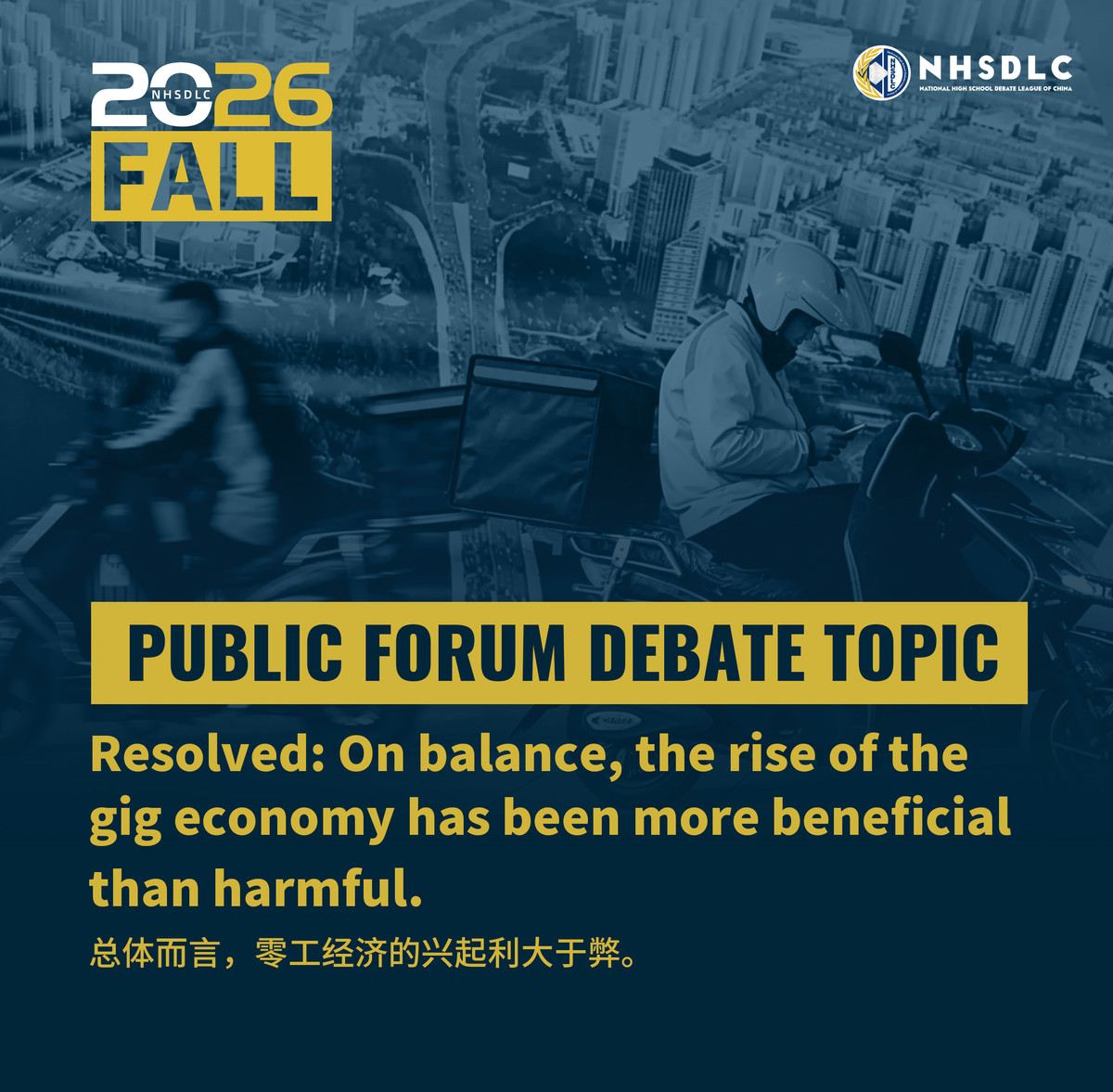
Fall Regional Tournament PF Motion

Resolved: On balance, the rise of the gig economy has been more beneficial than harmful.

Academic Materials

Main Research Packet Sample Cases Supplemental Packet

Extraction Code: 7iyn

● Junior World Schools Debate

Autumn Prepared Motions I Released

MOTION 1
This House Supports the decline of traditional retail in favour of e-commerce.
MOTION 2
This house regrets the professionalization of youth sports.

*Info Slide: Professionalization refers to the shift of youth sport from school and community play toward a structured commercial pathway: paid private academies, full-time training, contracts with clubs and agents, and athletes earning from sponsorship or their own name. Youth sports means sports participated in by those under 18.

Applicable Sessions:

  • Autumn Online Round I: Oct 17 - Oct 18
  • Suzhou Offline City Round: Oct 24 - Oct 25
  • Autumn Online Round II: Oct 31 - Nov 1
  • Autumn Online Round III: Nov 14 - Nov 15
  • Hangzhou Offline City Round: Nov 21 - Nov 22
  • Shanghai Offline City Round: Nov 28 - Nov 29

Academic Rules & Materials Download

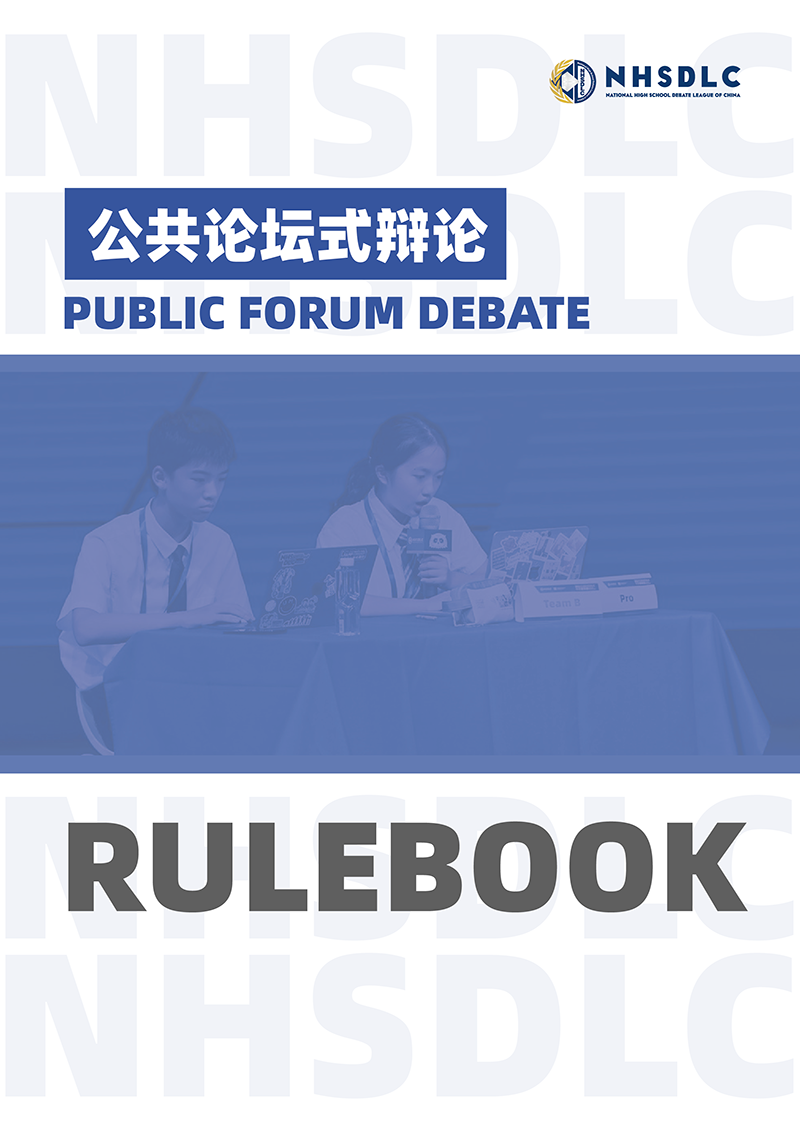
Public Forum Debate - Academic Rules Description

Public Forum, PF-Rulebook
Download

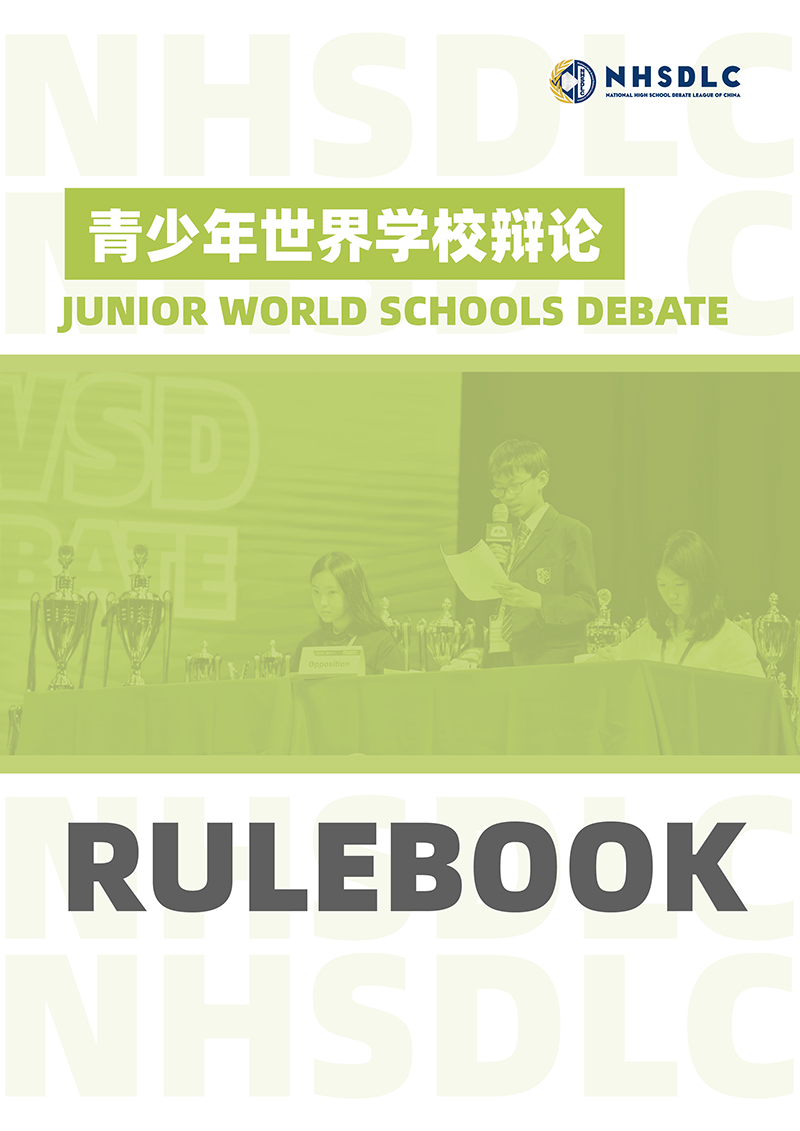
Junior World Schools Debate - Academic Rules Description

Junior World Schools Debate, JWSD-Rulebook
Download
Public Speaking - Academic Rules Description

Public Speaking, PS-Rulebook
Download

Lincoln-Douglas Debate - Academic Rules Description

Lincoln-Douglas, LD-Rulebook
Download

NHSDLC Exclusive Insights

Follow us to get more information!

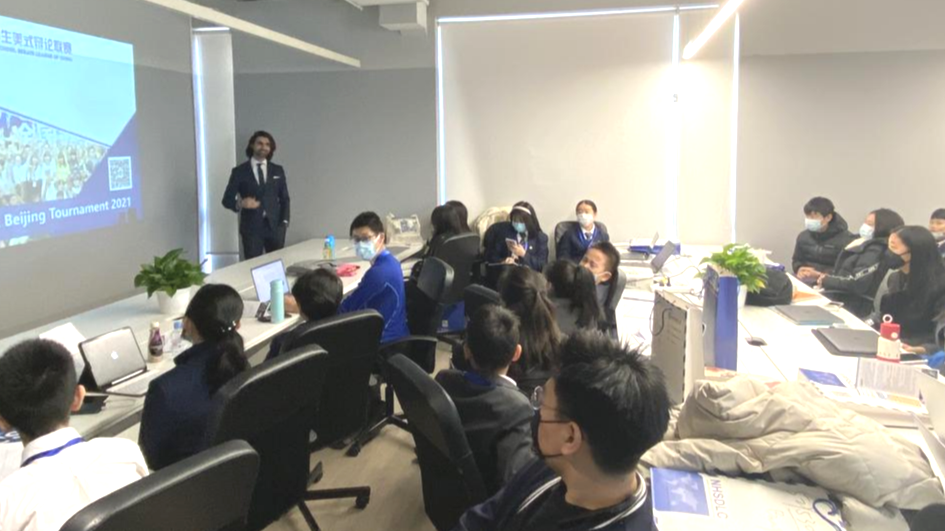
How to conduct research when you receive a motion? These 5 steps are essential!

Compared to impromptu performance, PF places greater emphasis on pre-challenge preparation. To become an outstanding debater, strong research capability is an indispensable academic literacy.
Learn More →

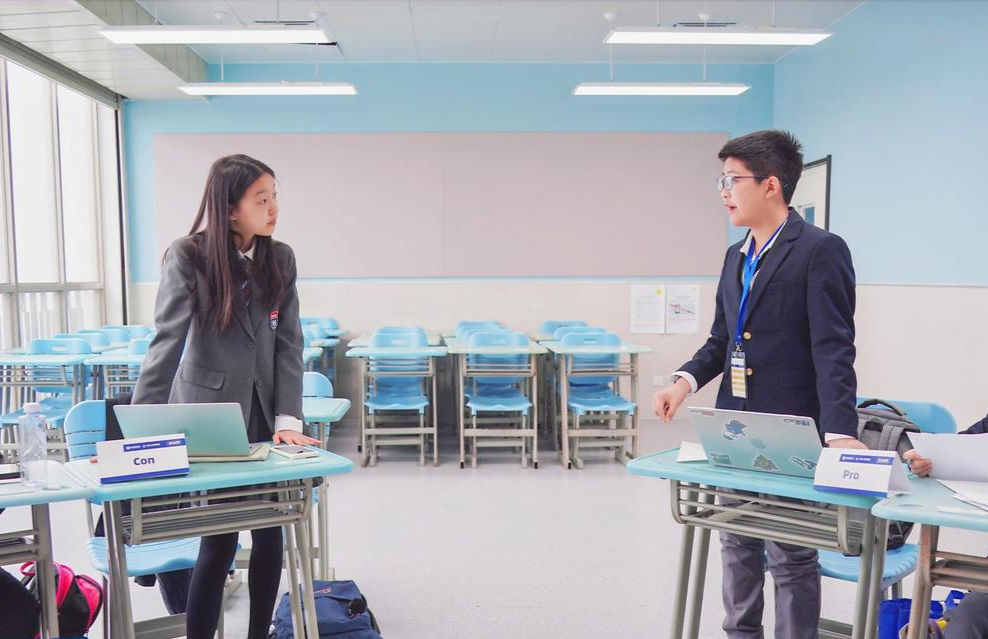
The 3 most frequently misused terms in debate challenges

Status Quo, Uniqueness, Clash or Clash Points.


Learn More →

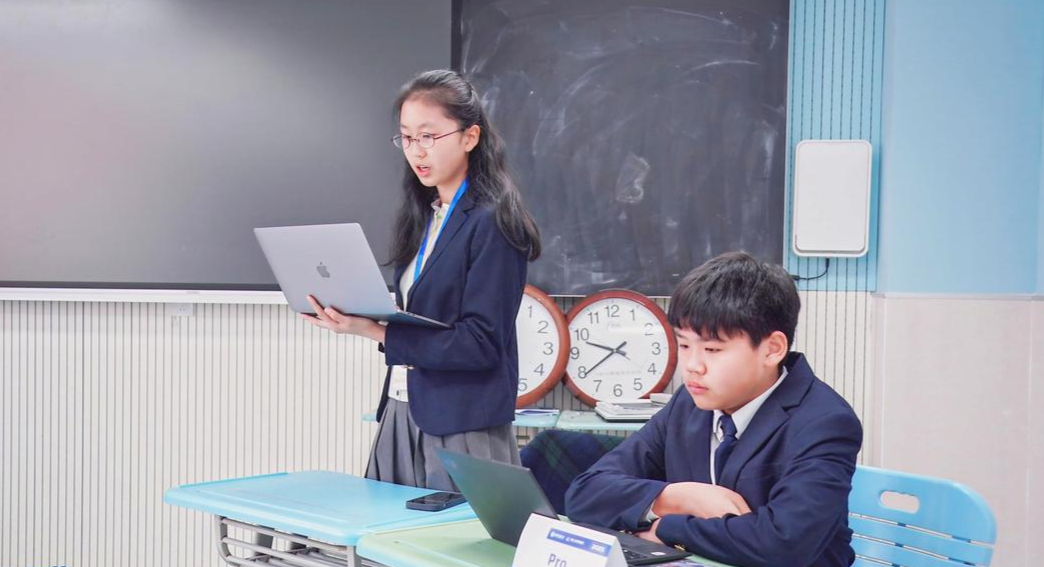
3 flexible movement tips for the Crossfire segment

In Public Forum Debate, crossfire is one of the most unique and vital segments. How can it be conducted effectively?


Learn More →

Build your arguments this way to get closer to victory!

In a debate, although there are various intense clash moments, the Argument as the "foundation" can often determine the final direction of a debate.

 

Learn More →

Past Judge Lineup


Swapnil Agrawal
University of Georgia


Fern Zhang
Smith College


Valeryia Liseichykava
Peking University


Nick Caputo
Carleton College


Lawrence Zhou
University of Oklahoma


Alex Parini
Peking University


Carly Ling
Shanghai International Studies University


Yuling Wang
University of California, Los Angeles (UCLA)


Harriet Zhao
University of Sydney

Caesar
Oberlin College


Betty Xu
University of Sydney